Saturday, January 23, 2010

Lost in translation ?


One of my friends in Maumere has left his guitar in my house for the last couple of weeks. Last night I noticed that there was a sticker on the inside visible through the soundhole so I picked it up, thinking I could practice my Indonesian reading.

This is what I read (and I quote exactly) :

"Since 1887 yahamas has making musicrhonical if its teache quality beauty yahamas guitars is a proted of thorogui musical kontage. Alla goodme empty salectif endoge under roundist untermental countri. Them this fones materials are supally crafted to become a yahamas guitar."

It's hard to disagree, really.

Thursday, January 21, 2010

Where have all the eggs gone ?

Shopping in a town like Maumere is qute easy.


There are two traditional markets for fruit, vegetables, fish and meat  - for meat, read chicken, although there is occasionally daging babi (pig meat) available if you go very early in the morning. (By the way, if you want a chicken you usually choose it on the hoof as it were. Most people then tie their purchase to their motorbike upside down by the feet and despatch it to the next world when they get home. However, the chicken seller will also do this messy business for you at the market if you want, thank goodness.)

And then there are the kios. As in most Asian countries, these are literally everywhere and are usually small bamboo structures in front of people's homes selling such staples as pulsa (phone credit), cigarettes, paraffin (for cooking stoves), washing powder, hair oil, sweets, superglue, motorbike cleaning products, instant noodles, sugar and of course, eggs. Every shop sells eggs, you see stacks of egg trays everywhere (your purchases are put into a plastic bag for you to carry home and one egg costs RP1.000). My egg consumption has soared while I've been here, they come with rice dishes, noodle dishes (i.e. almost everything), and are usually either fried or hardboiled.


Until this week, that is. On Saturday I went to the small kios near my house to buy some eggs for Sunday breakfast. No eggs.... oh well, I thought, that's strange. The next day I tried two other kios- no eggs. Very odd... On Monday, no eggs anywhere... Yesterday I went to the market where there are (usually) dozens of places to buy eggs. Guess what ? (Well, there were quails' eggs but they're not the same.) Eventually I asked why there were suddenly no eggs anywhere - the answer was the title of my last post - musim hujan, rainy season. Apparently all the eggs sold on Flores are imported (another surprise) and the egg boat hasn't been able to come because of the stormy weather....

Every day you learn something new I guess.

Monday, January 18, 2010

Musim Hujan


It's been a while since my last post, the reason for which is that there doesn't really seem to have been much to write about. Life has changed a bit in Maumere since the New Year as the rainy season (musim hujan) has arrived in earnest. What this means is prolonged periods confined to barracks listening to the torrential rain on the tin roof. Most days the rain starts at about 2pm (coincidentally and unfortunately the same time as I finish work) and it usually then continues well into the night with a few brief pauses. As my only means of transport is a motorbike, and the roads are awash with lakes and rivers everywhere, going out in the rain is really to be avoided if possible. Shopping has to be done at great speed in between the downpours – the market turns into a sea of mud in the rain – so I stock up on tomatoes and cucumbers when I can and often now my evening meal is the ever popular, but rather monotonous, mie telur (instant noodles with an egg to you). At least it's cheap, a packet of mie costs RP1.500 and an egg is RP1.000 so the whole exciting dish costs less than €0.20. Pineapples are still in abundance and two nice ripe ones can be had for RP5.000.


One unfortunate consequence of the arrival of the rainy season is that the number of mosquitoes has increased dramatically, with a big increase in the incidence of mosquito-borne diseases. At today's morning report in the hospital, I heard that there are 190 patients in the hospital (95% bed occupancy rate), of whom 61 are children. Of these, 33 are ill with DHF (Dengue Haemmorrhagic Fever) and 16 have malaria. [One very sad story - on Christmas Day, the 7 month old daughter of one of the managers in the hospital died in the private ward. She had been admitted with malaria but apparently died of anaphylactic shock following an injection. She was their first child.]


My reading has accelerated again as a result of this enforced imprisonment and so I'm eagerly awaiting the arrival of a long overdue book parcel sent by Ruth from Canada (posted in early November). The delivery time seems to have lengthened recently, I received a few parcels last year that arrived within about two weeks but my last one took over six weeks to turn up.


And finally, in other news - I now have just twenty more weeks to go in Maumere.


Wednesday, January 13, 2010

Wednesday, January 6, 2010

Going fishing at Ipir

Yesterday afternoon I took a trip to Ipir with Daniel, who works in the Blood Transfusion Unit in the hospital. Ipir is a small fishing village about 30kms away from Maumere on the south coast. There's a beautiful unspoilt beach there and two small fishing boats were preparing to launch and set their nets.

More photos to be found on Facebook by clicking HERE.

Thursday, December 31, 2009

Selamat Tahun Baru !! Happy New Year !!


It's New Year's Eve in Indonesia already so I'll be seeing in the New Year a little earlier than many of you - hope you have a good one !

There'll be more waffle on here next year - thanks for dropping by !

Wednesday, December 30, 2009

Roadside views

Just a short video clip taken from the bus window as we climbed and plunged along from Labuanbajo to Ruteng last Monday.

Tuesday, December 29, 2009

Back from the Dragons’ Den !


I hope you all had a great Christmas in whatever part of the world you are reading this. It's now Tuesday morning and I'm back in Maumere after a week away at the western end of Flores – I won't bore you with a blow by blow account but here's a quick rundown....


On Tuesday (22nd) I travelled by bus to Ruteng, where I was just three weeks ago for Festus's party. This is a twelve hour journey with just one meal stop at about 2 pm and so I was very glad indeed to arrive and have a wash and something to eat. The next morning the journey resumed at 7 am, arriving in Labuanbajo, the port at the western end of Flores at about 11 am. I had already booked a room in the Golo Hilltop Hotel on the recommendation of Anouk in Ruteng so made my way there and found a very nice Dutch-run place with a great view of the bay slightly to the north of Labuanbajo.


Labuanbajo itself is very tourist oriented (I saw at least 8 different dive shops) and has more English language restaurants and bars than all the rest of Flores put together so is certainly the place to come if you are craving some kentang goreng (chips), sizzling hotplate dishes (local speciality) and menus in English.


On Thursday, I set off on a boat trip to Rinca (about two hours away) to visit the Komodo dragons. The boat journey was about two hours long and we passed some of the multitude of islands that dot the sea to the west of Flores, it is surprising to see how many of even the smallest of these are inhabited and it's hard to imagine what sort of existence is eked out here as most of these islands are volcanic with no fresh water.


There are about 1100 Komodo Dragons on Rinca, with more on Komodo Island itself. They normally live to about 50 years old and apparently their saliva contains about 50 different types of bacteria – if one catches up with you, you are more likely to die from septicaemia than from being eaten, especially as the nearest hospital is at least two hours away and is not up to much anyway. They can run at about 15 kms/hr but when I was there they were all snoozing in the midday sun, their most active times are early morning and late afternoon (outside visiting hours !). They are carnivorous creatures and a group of three or four komodos will make a buffalo last about four days.


However, they are also cannibalistic so their young very sensibly take to the trees as soon as they hatch from their eggs after nine months (I wonder if I got that right, that seems very long ?) until they are three or four years old. There are some safety precautions in place to prevent tourists being eaten : you can only wander around with a guide (who is armed with a long forked stick !), visitors are only allowed in the middle of the day when the dragons are laziest and - well, that's it really.


After my two hour very hot hike around the island it was time to board the boat and return to Labuanbajo - well, almost to Labuanbajo. A loud bang from the noisy engine, followed by total silence put paid to that plan but fortunately we were within mobile phone coverage and able to call for help so were towed in an hour or two later than planned. (And no, I didn't ask what we would have done if we had broken down thirty minutes earlier where there was no phone signal.)

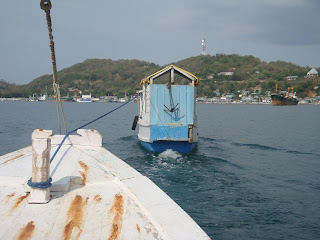


The next day (Christmas Day) I boarded another boat to Pulau Seraya Kecil (Pulau = island, kecil = small or little) for two days of doing nothing. This is a fabulous place, a white sandy beach, about a dozen beachfront bungalows, a restaurant with a very limited menu (but plenty of cold beer), and a great coral reef for snorkelling. Electricity is provided by a generator which runs from about 6pm to 10pm every day and fresh water is brought to the island by tank and so is in very short supply and anyway is only available when the generator is running to power the pump. A very relaxing two days spent reading, swimming, snoozing and generally doing nothing .....


And then, THE BUS AGAIN..... Sunday started with the boat from Seraya to Labuanbajo, then the bus from LBJ to Ruteng.


Monday was another twelve hour marathon from Ruteng to Maumere, arriving home at 7 pm absolutely knackered. Today (Tuesday) I am relaxing at home, having just returned from the market with eggs, mangoes, bananas, a pineapple, tomatoes and cucumber so it will be French toast and pineapple for breakfast and tomato and cucumber salad for lunch. Tomorrow, back to work...


Thursday, December 17, 2009

Christmas is coming..


But there isn't much sign of the geese (or anything else for that matter) getting fat here. Even though this won't be the first time I've spent Christmas in a hot country, it still feels really weird to hear Christmas carols in sweltering weather. Last night, I passed a house where a choir was rehearsing "Joy to the World" in good two part harmony (Indonesian men don't seem to be able to sing below tenor) and there are some Christmas decorations up in the shops, and a Christmas tree - with snow - in the hospital lobby.

There are two official "tanggal merah" (red days on the calendar) - 24th and 25th December - but I am assuming that nobody will turn up at work on Saturday 26th as every holiday I've experienced so far seems to gently and unofficially extend itself.

I've been asking about what happens at Christmas here - there is some special baking done (which is unusual in itself as baking generally does not feature largely here) and families will attend church, visit their neighbours and bring Christmas greetings. I asked "do you give gifts ?" and have been given different answers - one colleague answered me with "To whom ? Why ?" - apparently this was a rather weird notion ! Another told me that she will probably give her three children a small toy each but when I asked if she would be giving her husband a gift she thought this was hilarious ! It's certainly seen as a far less significant festival than Easter where everything closes up for a week or so - for instance, young people have no problem going away or visiting friends at Christmas but wouldn't dare be absent from home at Easter.


As for my own Christmas, I've more or less decided to take a bus trip (2 days travel) to Labuanbajo at the western end of Flores and from there visit Rinca Island. This is one of the places where the famous Komodo Dragons are to be found (but I'm not planning to get too close for reasons which will be become clear when you read the article I've linked to). As well as Rinca (which will be a day trip) I might visit one of the resort islands near Labuanbajo for a day or two chilling out without electricity before setting out for the two day trip back to Maumere. I haven't booked anything in advance but this is the low season for tourism here so I hope there won't be too many problems.I'll probably book my travel in advance though, as I expect many people will want to pulang kampung (return home to their village) for Christmas so buses may be busy.    


This will probably be my last post for a few days (I'm not sure what blogging chances I'll have during the holiday) so I'll take this opportunity to wish you all a very happy Christmas wherever you may be. I've been rambling on here for just over one year now and it's extraordinary (to me anyway) to think that this waffle has been viewed over 10,000 times since I started posting. You can see the number of hits on the left hand side if you scroll down a bit. I thank you all for the comments you've left, the suggestions you've made and the support you've offered as I sweat quietly out here, so selamat natal, happy Christmas to you and yours and I wish you all every blessing !          

Saturday, December 12, 2009

Seventeen years on..

Today (12th December) is the anniversary of the earthquake which hit Maumere and nearby islands such as Pulau Babi in 1992, resulting in the loss of more than 2,500 lives and the destruction of most of the buildings in the town, including the hospital. The current hospital was opened on a new site in 1998.

I have found it quite odd how little I have heard about this event given how recent it is (only 17 years ago) and how destructive it was. The little I have heard has been fragments of stories from colleagues at work and has had to be dragged out of them. I think that this lack of information is probably due to a number of factors :
  • People here die young anyway. As I've already mentioned, life expectancy in Indonesia is much lower than in Ireland (68 years compared to 80, according to the WHO) so there are fewer people around who remember what happened and also the death of people at a young age is accepted as more commonplace than in developed countries. This situation has improved significantly recently so life expectancy in 1992 must have been even lower.
  • There is generally a reluctance to talk about "bad things". This is connected to the strong animist traditions that sit by side with the Christian (mainly Roman Catholic) ethos in Flores. I've noticed that there is a great reluctance to talk about these bad things and I frequently hear "Satan" being mentioned !

  • I find it hard to imagine what life in Maumere and the surrounding areas must have been like seventeen years ago. Internet access here even today is limited and unreliable, and there was certainly no internet access here at the time of the earthquake. Today, almost nobody here has a camera so there were probably no photographic records of what happened and also the heat means that dead bodies have to be dealt with extremely quickly so the whole business of dealing with funerals was probably over within a day or so. It's still possible to see where some of the town has been rebuilt (but never quite finished !).


Wednesday, December 9, 2009

Billy the Kid at the party

I'm now back at work on Wednesday morning, having returned from Ruteng yesterday. On Thursday last, we had more or less constant rain for about six hours so I decided to leave the motorbike at home and let someone else do the driving instead (and of course, it hasn't rained since..). There are a number of options for inter-town travel on Flores ranging from a truck to buses to what is called a Travel (a seat in a shared 8 seater car). I opted for the latter and was collected from the hospital at 7.30 am on Friday morning. I then sat in the car for four hours waiting until we had enough passengers on board to justify departing and eventually arrived in Bajawa at 7.30 pm, exactly twelve hours later (driving time 8 hours). I won't describe the rather hair-raising journey but I now know that an 8 seater car can fit 12 people (plus luggage) if you push hard enough.

On Saturday morning I continued to Ruteng (another four hours) in the luxury of a private jeep owned by a friend from Bajawa and then the party started !
Festus has been in Ruteng as a volunteer for two years and is now returning to Kenya to look for a job (he is a water engineer and has been working with a local NGO here helping villages to arrange secure clean water supplies). In his time in Ruteng he has obviously amassed a large circle of friends who all turned out on Saturday to wish him farewell. Unusually for Indonesia, there were no speeches (they were being saved for a lunch on Monday) so there was just music, dancing and drink. Oh, and of course the food !

The goat (see here) had been seen nibbling the grass outside the office where the party was to take place on Saturday morning but by the time I arrived had been despatched and was on the fire behind the office.

The party got underway with plenty of dancing and drinking and stage one of the meal (Billy the kid wasn't scheduled to appear until later on in the evening).
 
At last, the special guest made his appearance and was unceremoniously dumped on the table with a knife for self service snacking - and it was delicious !


As well as saying goodbye to Festus, the weekend was a great opportunity to catch up with Mark and Anouk, two Dutch volunteers based in Ruteng who were in the same intake group as me all the way back in February. Ruteng struck me as a nice place to be based, smaller than Maumere but a good bit cleaner and a lot cooler (long trousers and sweater required, plus a blanket at night).


My return journey to Maumere started on Monday morning when I left Ruteng by bus and travelled to Ende (uneventfully except for a puncture and a dead dog). I spent the night in Ende and travelled on to Maumere on Tuesday, arriving at about 12.30 pm. The total distance from Maumere to Ruteng is about 400 kms.

Arriving back in Maumere, I was struck (literally) by the heat - there is a massive difference and I found it very difficult to sleep last night,even with my electric fan strategically aimed. Today it is very very humid (unusually so) and, to maker matters worse, a  team of auditors will be occupying the (air conditioned) office that I normally use for the next two weeks ! 

So, goodbye Festus and good luck with whatever comes next !


Wednesday, December 2, 2009

Pesta in Ruteng !

As the number of VSO volunteers in Indonesia continues to dwindle (see earlier posts about the long running saga of visa negotiations that has led to the suspension of VSO's health programme), this weekend sees another departure as Festus, a Kenyan water engineer, comes to the end of his two year placement and heads home to seek paid employment in Africa. Of course, no departure would be complete without a pesta (you can guess the translation !) so I'm heading westwards on Friday to bid farewell and also visit two Dutch friends who were in the same intake group as me all the way back in February.

Mark & Anouk (and also Festus) live in Ruteng which is about 400 kms west of Maumere. I plan to make this marathon journey by motorbike with an overnight stay in Bajawa about 280 kms from here en route (that 280kms should take about 10 hours to accomplish). This will be my first time travelling past Ende (which is about 150km from Maumere) so I'm very much looking forward to the opportunity to see more of Flores and hoping that the rain will hold off.


Bajawa is near the site of the 2003 discovery of the Flores "Hobbit" which still divides the scientific community as to whether it is really a separate species or not.


I've been told that the party preparations are well underway and that 40 litres of moke (as the local hooch arrack is known here) have been prepared and that a suitable goat has been identified for our dining pleasure.

On the return journey,leaving on Monday morning, I'll try to make it from Ruteng to Ende on the first day, and then the final 150km from Ende to Maumere on Tuesday.
 

Monday, November 30, 2009

A Very Important Visitor...and why not to eat mango for breakfast


Not a lot to report last week really, it's still mango season here so there are enormous delicious mangoes available in the market (about RP5.000 or €0.30 for four or five of them). They make for a great breakfast but apparently it's a well known fact among Maumereans that eating mangoes first thing in the morning is not a good idea. I can now report that there appears to be a sound basis for this wisdom as Tuesday was spent at home instead of in the office (fortunately home is only about two minutes from the office..).


Saturday saw two more party invitations, this time it was graduation day at UNipa, one of Maumere's third level institutions and I was invited to two family celebrations for newly qualified nurses. At the first of these, we were seated indoors (quite unusual for here but this was obviously a well-off family as was evident from the house construction and the furniture). The wealth didn't extend to air-conditioning unfortunately and the heat was unbelievable so I would have preferred to be seated outside in the gentle breeze rather than in a pool of my own seat on a squeaky sofa !


So, on to the VIP..


 On Sunday, the hospital was gripped with excitement as we awaited the official visit of the newly appointed Minister for Health, all the way from Jakarta. The new minister (who is a doctor) worked in Maumere for three years when she was newly qualified and her husband is either from Flores or also worked here (I couldn't figure out which) so she was keen to pay a visit to her old home. She was due to arrive at the hospital at 12 noon and spend two hours visiting three wards and meeting staff and patients, followed by a tree planting ceremony and a bunfight. She turned up bang on time at 2.15 p.m. (which is about normal) at the head of a cavalcade of at least twelve official cars all crammed with hangers on, was greeted at the front door by some traditional musicians and dancers and Dr. Asep (the hospital director) and whizzed around the three departments, including the ICU – I'm not sure what the still unwritten infection control policy will have to say about one hundred visitors all marching in there ! - in double quick time. Unfortunately the long awaited rainy season decided to start just as the tree planting ceremony was about to take place so that was quickly shelved and she was then running so late that the bunfight (carefully prepared by Dr. Candida, Dr. Asep's wife) in the conference hall was left to the staff to fight over after her departure.


Dr. Asep and the newly printed organisation structure in the main entrance hall of the hospital.


The musicians and dancers preparing for the Minister's arrival.


Dr. Candida (left) preparing the snacks


Dr. Asep greets the Minister


The hole is filled by the rain rather than the tree...


Everyone turned out in their best bib and tucker including my friend Petrus, who I suspect designed his uniform himself as he is the only security guard in the hospital who dresses like this (and he is really proud of it as you can see !)


Thursday, November 19, 2009

Duck and chips !

It's not all rice here, there are quite good potatoes available also for about RP10,000 (€0.65) per kg. Last Saturday evening I bought 1.5kgs of big spuds, Peter made them into chips and our friend Teresa arrived with three portions of bebek bakar (grilled duck) from a local rumah makan. Enak sekali, as they say around these parts !


Wednesday, November 18, 2009

Corruption update

I see that Transparency International has just published the 2009 Corruption Perceptions Index (see this earlier post for more on this). It's interesting to see that Ireland has moved up the table to 14th place with 8 points (formerly we shared 16th place with the UK on a score of 7.7). The UK is now in 17th place, still with 7.7 points.

However, I'm also pleased to see that Indonesia's position has improved slightly too - up from 126th place with 2.6 points to 111th this year (2.8 points).

Somalia still languishes at the bottom in 180th place with 1.1 points while (rather surprisingly to me at any rate) New Zealand is in 1st place with 9.4 points.

Tuesday, November 17, 2009

Gestation Period ?

This is the beginning of my fortieth week in Indonesia, a duration which the same as the gestation period for humans. I could get very allegorical about what my 40 weeks here has produced (apart from the loss of about 13kgs !) but I'm not going to do that.

Last week, an Indonesian friend asked me whether I was enjoying living here and what were the biggest differences between my life in Ireland and my life here. I listed off a few of the obvious and easier to explain differences (weather, food, motorbikes etc.) but the question did prompt me to think about some of the larger contrasts between living in a rich country and living in a poor one (and believe me, for those of you in Ireland who are dreading the budget on 9th December, Ireland is still a very rich country).


The big obvious one of course is money, but more importantly access to money. You need money to get money. Everybody that I have met here so far, whether living a hand to mouth subsistence existence in a village or working as a government employee on a regular salary, operates with practically no savings and therefore no backup in the case of emergency. There are government owned pawnshops in most towns and as most people don't have bank accounts, this is the first port of call in an emergency. The credit union movement is also quite well established here and VSO is planning to place a volunteer with the Credit Union head office in Maumere next year to help them develop their management skills. Of course, access to finance and seed capital is recognised as one of the biggest limiting factors in preventing people from becoming self sufficient in even the smallest ways - if you want to open a small kiosk selling cigarettes or a sewing business, you need some start up money to buy your initial stock or your sewing machine. This is why micro finance or microcredit operations are proving to be so important in helping to break the poverty cycle.

Another big difference between life in Ireland and life here is connected to lack of infrastructure. This one is pretty significant and affects many aspects of life, here are just a few examples :


Transport
Transport in Flores is privately provided and not subsidised. By Western standards it is cheap (a trip to Ende, about 160 kms away, will cost about Rp70.000 or less than €5 for one seat in an 8 seat car and will take about 4 to 5 hours) but for a poor villager this is a huge sum of money.   


Roads
Are not great (this is why the trip to Ende takes so long). In the rainy season many are impassable except by truck so connections between towns on the same island are difficult. 


Electricity
I am lucky to be living in the hospital as we rarely experience power cuts. However, another volunteer living in Maumere can now predict when her electricity will be off - every fourth night from 6pm to 10 pm. A volunteer in Ruteng (western Flores) tells me that they have no listrik every day between 12 noon and 4pm. Part of the problem is infrastructure - Maumere has expanded in recent years and more houses now have electricity but the power station can't keep up - but availability of fuel (diesel) for the generating stations is also a problem. As the rainy season approaches, there is a higher risk of sea tankers not being able to dock and unload and road tankers not being able to make it through the landslides.


Water
Again, I'm lucky. I have plenty of running water for washing which has been available almost without interruption and I can afford to buy 20 litre bottles for drinking. However, villagers who do have water have to collect it from a communal well or tap, drag it home and then boil it. Access to water in some villages is almost non-existent and the focus of many development projects is on providing access to clean water. The link between water and health does not need to be spelled out.   


Healthcare
Two of the biggest contributors to the stark difference in life expectancy between developed and developing countries are access to healthcare and education about healthcare. There is lots of reading material available on the WHO's site (HERE for example) and you can also contruct interesting comparisons between selected countries using chosen indicators HERE.


There are of course lots of other differences which I guess are really the luxury aspects of living in a rich country : entertainment options, internet access (with obvious implications for educationand business), nice restaurants, access to more than ten things to eat (but think of all those food miles), refuse collection services - ah, the list is endless but is often what your tax is spent on (apart from servicing the growing national debt of course !).

Anyway, that all got a bit serious, I'm off to do some  work now. For further reading, look up the UN's Millennium Development Goals here.